
Special Educational Needs and Disabilities (SEND) at St Anthony’s

At St Anthony’s and across the Multi-Academy Trust, we strive to meet the needs of all our pupils.
We work closely with the local authority in order to ensure that provision meets the needs of our pupils. We direct our families to the Wolverhampton Local Offer which sets out all services available to support children and young people with special educational needs and/or disabilities, from birth to 25 years, and their families.
Please click here for more information about the Wolverhampton Local Offer.
Parents are able to access the Wolverhampton Information Advice and Support Service for impartial information, advice and support on matters relating to a child or young person’s special educational needs or disability from birth to 25 years.
We believe that all pupils are entitled to receive a high quality, ambitious and engaging curriculum, regardless of need or disability. We aim to fulfil the potential of every pupil by offering a broad and balanced curriculum, often delivered in innovative and creative ways. Our inclusive academy welcomes all pupils and values them as individuals, treating them equally and with respect. We believe that all pupils have the right to have their own individual needs recognised and addressed to achieve success.
Our use of a wide range of resources and strategies enables all pupils to develop the skills and attitudes to become independent learners and communicators, both at our academy and through to adulthood. At St Anthony’s, all teachers are teachers of pupils with SEND and it is therefore a whole academy responsibility to ensure that pupils’ needs are addressed. Through staff working together as a team, and in partnership with pupils, their parents/carers or with external professionals we strive to ensure that all pupils with SEND are provided with an environment in which they can flourish.
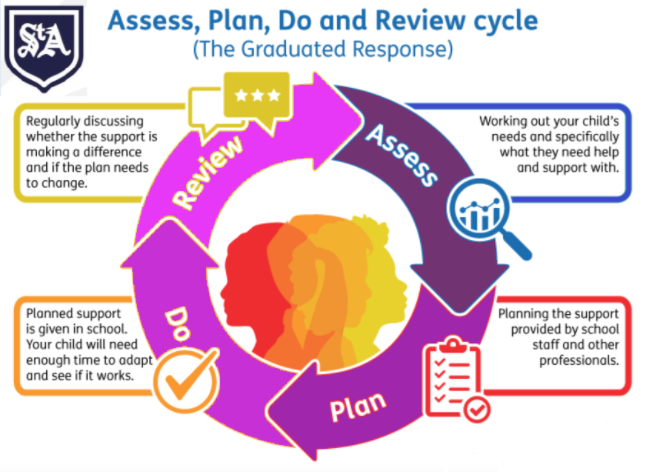
St Anthony’s is a mainstream academy with an inclusive and ambitious ethos for all pupils. Whilst most pupils’ needs are met within the classroom there may be some pupils who require support above and beyond many of their peers. Additional support is delivered in many ways, at different stages and is usually referred to as ‘the graduated response’.
A small number of pupils are also educated in St Theresa’s Class at St Anthony’s. This is a specialist provision, primarily supporting pupils who have significant, complex needs including speech, language, and communication needs. Some of these pupils receive their full-time provision within this class whilst others share time across the day with their mainstream peers. The timetable and curriculum are bespoke to meet their individual needs.
How will my child with special educational needs or disabilities be supported St Anthony’s?
Initially concerns may come from class teachers, parents/carers or previous settings. Typically, a conversation will take place between the class teacher and parent, sharing these concerns before beginning at wave 1 on the pathway of additional need and agreeing next steps.
Wave 1: At the first stage the class teacher delivers quality first teaching directly to all pupils with small adaptations made to ensure all pupils can access the curriculum. This may include:
- Revisiting previously taught concepts and building on from where the pupil is at
- Delivering new learning in small chunks to reduce memory overload
- Providing opportunities to overlearn the new concepts, in different contexts
- Checking in with the pupil to ensure he/she understands what to do and what is expected of them. Support is offered to address misconceptions
- Using models and visual prompts to aid the pupil
- Enlarging the text or simply reducing the amount of text presented at any one time
- The use of an individual whiteboard to give answers visually or to record words or questions of importance
- The use of maths equipment to aid calculations
- Planning for opportunities to try new things in a ‘safe’ space
- Considering where the pupil sits in the class
- Providing the pupil with specialised equipment e.g. pencil grip, sloped board, coloured overlay
In addition, class teachers will be constantly observing pupils, offering feedback on their work, and making use of termly assessments.
If, after a minimum of 6 weeks, there is limited impact using a range of the above strategies, then the class teacher would speak with the SENDCo and outline concerns and strategies tried. It may be recommended that wave 1 strategies are continued for longer (monitoring – usually for at least 2 ADPR cycles) or we move to wave 2.
Wave 2 is begun if the strategies tried at wave 1 have not reduced concerns or begun to close the gaps in learning. Parents/carers and teachers will review the situation and agree the next stage. This will include adding the pupil to the SEND register. At this point each pupil will receive an individual SEND Support Profile which is completed termly, and shared with parents and pupils. SEND Support may include 1 or more of the following:
- Direct intervention from the class teacher or a learning support practitioner that is above what most of the class receive. This will often happen within the classroom and may be 1:1 or within a small group. Frequency will vary but should be occurring at least once per week
- Targeted support within the classroom – either from a teaching assistant, the class teacher or both.
The majority of the pupils will have their needs met at wave 1 or 2 (SEN Support) and will continue to receive support at this level whilst it is needed, as they move throughout the school.
However, a small percentage of pupils will require additional support that is significant and long-term. Advice from specialist professionals is sought (Wave 3).
Wave 3 provision usually involves other professionals coming into school to work with pupils, their parents and teaching staff. The pupil is considered to have a high level of SEND and will probably need long-term support in school. At this stage parental permission is sought to involve professionals from outside school and in many cases a report or parental consultation is involved. Professionals include:
- Educational Psychologists (EP)
- Specialist Teachers
- Behaviour Support and Advisory teachers
- Sensory Inclusion Service
- Speech and Language Therapists (SALT)
- The school nurse
- Occupational Therapist (OT)
- Medical professionals
On a very small number of occasions school will need to make a referral to a panel of experts for additional support or funding to meet the needs of a pupil. This could be related to any area of SEND but defines the point at which the school is finding it difficult to meet the needs of the pupil from within the resources of the school. Families who reach this point have typically been working with the school for a long time and have a close working relationship with school staff, unless they have already been identified as having high needs prior to joining St Anthony’s.
Through regular Team Around the Child reviews, it will be determined as to whether this child would benefit from an Education Health and Care Needs Assessment. If so, they may go on to receive an EHCP, which is then reviewed on an annual basis (See the Wolverhampton Local Offer website for more information about EHCPs).
At any point in the process, a parent can request a telephone consultation from an Educational Psychologist. Please see the Wolverhampton EP service website for information about how to access this consultation.
Please see our Policies page for our SEND Information report and our SEND Policy.